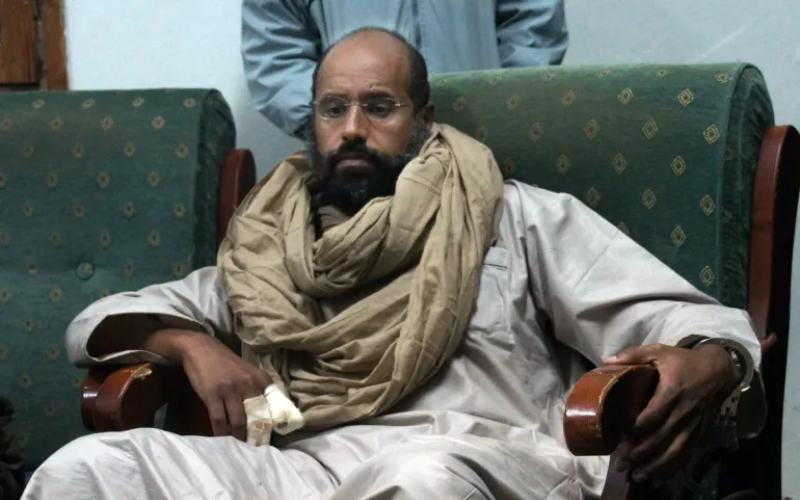
Saif al-Islam Gaddafi, the son of Libya’s late longtime ruler Muammar Gaddafi, has been shot dead.
His French lawyer, Marcel Ceccaldi, told AFP that Saif al-Islam, 53, was killed on Tuesday afternoon after gunmen stormed his home in Zintan, western Libya.
“He was killed today at 2:00 pm (1200 GMT) in his home by a four-man commando,” Ceccaldi said.
Earlier, announcements posted on Facebook by Saif al-Islam’s lawyer Khaled al-Zaidi and political adviser Abdulla Othman said he had been killed, without giving immediate details. Othman later told Libyan media that armed men attacked Gaddafi inside his residence in Zintan, a town about 136 kilometres southwest of Tripoli.
In a subsequent statement, his political team said “four masked men” forced their way into the house, disabled security cameras and carried out what it described as a “cowardly and treacherous assassination”.
Othman also told Libya’s Al-Ahrar television that the attackers “executed him” after cutting surveillance systems. It remains unclear who was behind the killing.
Ceccaldi said a close associate had warned him days earlier of growing security concerns around Saif al-Islam, adding that the head of the Gaddafi tribe had offered to send guards, an offer he reportedly declined.
Reacting to the killing, Khaled al-Mishri, former head of the Tripoli-based High State Council, called for an “urgent and transparent investigation” in a social media post.
Although he never officially held public office, Saif al-Islam was widely regarded as his father’s heir apparent and de facto second-in-command in the years before the 2011 uprising that toppled the Gaddafi regime.
Western-educated and fluent in English, he cultivated an image as a reformist, playing a key role in efforts to normalise Libya’s relations with Western nations in the early 2000s, including negotiations on abandoning weapons of mass destruction and compensation talks over the 1988 Lockerbie bombing.
A graduate of the London School of Economics, he publicly called for a constitution and political reform. That image collapsed during the 2011 Arab Spring revolt, when he aligned himself with the regime and threatened “rivers of blood” as security forces cracked down on protesters.
Saif al-Islam was captured in November 2011 while trying to flee Libya and was later sentenced to death in absentia by a Tripoli court in 2015. He was freed in 2017 under a general amnesty and had since lived largely out of public view, moving frequently, according to Ceccaldi.
Wanted by the International Criminal Court for alleged crimes against humanity, he re-emerged in 2021 to announce a presidential bid, a move that reignited political tensions and contributed to the collapse of Libya’s planned elections.
Libya has remained deeply divided since the NATO-backed uprising that overthrew Muammar Gaddafi, with rival administrations competing for power amid ongoing instability.