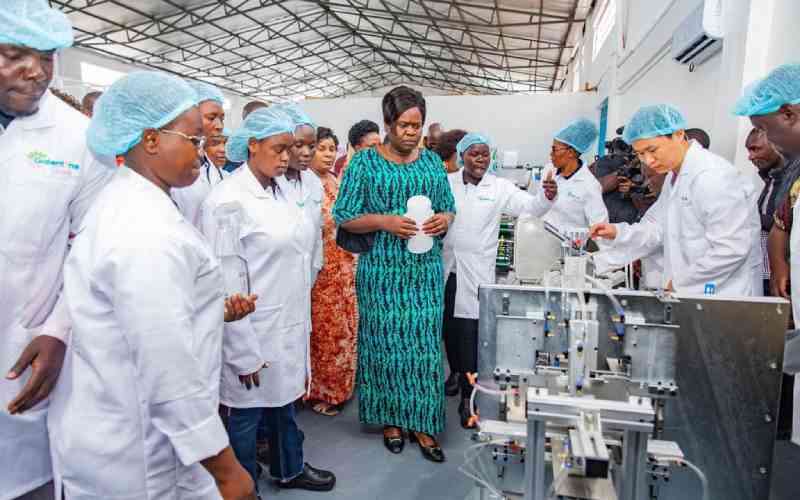
Homa Bay County has launched a women-led sanitary pad manufacturing factory aimed at addressing period poverty, reducing school absenteeism among girls and creating jobs for women.
The Galentine Care Sanitary Pad Factory, located in Kasgunga Ward, Suba North, was officially inaugurated on Tuesday by Governor Gladys Wanga alongside county leaders, Members of Parliament, development partners and community representatives.
The facility, run by Galentine Care Limited, will manufacture locally produced sanitary pads selling at prices up to 60 per cent lower than current market rates, with packs retailing from as low as Sh50. Part of the production will be donated to schools within the county.
Speaking during the launch, Governor Wanga said the initiative offers a practical response to challenges facing girls and women in the county.
“This is not charity. This is a social enterprise rooted in dignity. Period poverty, teenage pregnancy and household poverty are deeply interconnected,” she said, noting that improved access to sanitary products would help keep girls in school while strengthening the local economy.
Homa Bay records the highest teenage pregnancy rates in the country. County data shows that more than 17,000 teenage girls became pregnant in 2024, accounting for about 22 per cent of all reported pregnancies, with more than 10,000 new cases recorded by mid-2025.
Leaders and education stakeholders say lack of access to sanitary pads increases vulnerability among school-going girls, with some forced into exploitative situations to afford menstrual products.
“No girl should miss school because of her period,” said Millie Mabona, Suba North MP.
“This factory shows that when we invest locally, we can protect dignity, create jobs and secure the future of our girls.”
Reiterating their remarks, Galentine CEO Peter Macodida said: “Women told us clearly that cost and access were the biggest barriers. We found that 97 per cent of women in Homa Bay could afford pads priced at Sh50, and that shaped the entire project”.
Defence and gender advocates present at the launch said the factory could serve as a model as Kenya debates policies on menstrual health management and access to sanitary products in schools.
“This factory is the fulfillment of a long-held dream,” said Jane Anyango of Polycom Girls. “We are moving from emergency responses to a sustainable, community-driven solution that keeps girls in school.”
At full capacity, the company aims to grow its workforce from 17 women to more than 200 within three years and reach over 430,000 women by 2028, while reinvesting profits into job creation and free pads for schools.